
Monday, November 26, 2012
Mexicans in America

Questions for A Better Life

1. Do you feel the movie is authentic? Explain.
2. What is your impression of the film so far?
3. What are some of the contrasts and juxtapositions we see in the city landscape of Los Angeles?
4. Do you think their life is better in Los Angeles?
5. In the scene where a police officer asks Luis to remove his shirt to see his gang tattoos, what emotions were provoked for you? What is this behaviour an example of?
6. Luis' father, Carlos, is an illegal immigrant. How is this problematic for Luis?
7. How does Carlos' attitude (towards his culture, towards his father) change throughout the movie?
8. Is Carlos similar to his father?
9. When Carlos asks his father, "why do all these poor people have kids? What's the point?" his father responds, "don't say that." Why does his father respond this way? What is he trying to teach his son?
10. In general, what have you learned about immigration in America through this film?
Sunday, November 4, 2012
Seconda Media Homework for this week
Hello Seconda Media!
I know this blog is new for you, but I wanted to give you some instruction for this week.
For English:
1) Please complete all unit 13 workbook exercises.
2) For a grade, please write a 200-250 word play (pezzo teatrale). Please invent a new ending to A Tell-Tale Heart. Just like the play we read in class, be sure to use ADVERBS before every line so that that we understand how the characters are doing and saying things. If you are confused about how to write a scene from a play, use the play we read in class as your guide! Here's a short example of lines from a play:
Scene 3
A: (rudely) Move your chair!
B: (patiently) Only if you say please.
A: (annoyingly) Fine! Pleeeease.
For Geography: please study all of your vocabulary and prepare for a written vocabulary quiz.
Thank you!
Prima Liceo - Homework for this week
Prima Liceo!
While I am gone, please make sure to complete all unit two workbook activities. Please study any vocabulary we have covered since our last exam and prepare for a quiz and oral test on units one and two of New Headway. For Geography, I would like you use this website to search an Ellis Island passenger name (that is, an immigrant bound for America at the turn of the century).
http://www.ellisisland.org/search/passSearch.asp
Try putting in your own last name! Write a 300-350 word diary entry from the perspective of that person. Pretend he/she is on the boat on the way over to America. Write about: where you're from, why you're coming to America, some of your hopes and fears, what you are going to do once you get there.
Also, please read any material you have in your text on migration. Know that the following week we will have a written and oral test on population and migration.
Thank you!
While I am gone, please make sure to complete all unit two workbook activities. Please study any vocabulary we have covered since our last exam and prepare for a quiz and oral test on units one and two of New Headway. For Geography, I would like you use this website to search an Ellis Island passenger name (that is, an immigrant bound for America at the turn of the century).
http://www.ellisisland.org/search/passSearch.asp
Try putting in your own last name! Write a 300-350 word diary entry from the perspective of that person. Pretend he/she is on the boat on the way over to America. Write about: where you're from, why you're coming to America, some of your hopes and fears, what you are going to do once you get there.
Also, please read any material you have in your text on migration. Know that the following week we will have a written and oral test on population and migration.
Thank you!
Saturday, September 29, 2012
Speaking of the Kurdish Nation...
Wednesday, September 26, 2012
Tuesday, September 25, 2012
ROMEO AND JULIET PROJECT
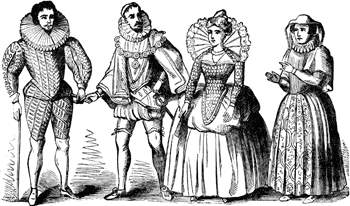 Project Objectives:
·
To read and understand a Shakespeare play
·
To interpret
and prepare a monologue or soliloquy
·
To practice your speaking and performance
skills
·
To creatively interpret your monologue or
soliloquy through a thoughtful video demonstrating your full grasp of the
meaning of the monologue or soliloquy.
Project Outline:
·
Read Shakespeare’s Romeo and Juliet. You may buy the English/Italian version if you
like; however, you may read a free
version through Google Books. Keep in mind, our goal is not to dissect or
over-analyze the play. You will be
reading this at home on your own time.
It’s really for your enjoyment.
So have fun with it!
·
Choose a monologue or soliloquy you like
from the play. I’ll help you as you go along to understand it’s specific
meaning and to work on pronunciation and delivery.
·
Memorize the monologue/soliloquy.
·
Prepare your delivery of the
monologue/soliloqy.
·
Deliver monologue/soliloquy in class and
present your video interpretation.
· Projects are due on December 13th.
Video Project:
·
Use a home camera to visually interpret
your monologue. You must recite your monologue in the video, but memorization
is not the major goal here. You should present your monologue in a way that
creatively demonstrates your interpretation of it. You can put this video onto
a usb key and we’ll make sure it works before you present.
Subscribe to:
Posts (Atom)